Studying at Accademia di Belle Arti di Roma
Why Rome?
This year, I’ve fallen in love with the city of Rome. No other city in Europe offers such a rich blend of culture, art, architecture, and beauty, all complemented by warm weather, incredible food, and the irresistible dolce vita lifestyle. Rome overflows with things to see and do, and it feels like a never-ending adventure. Even after months of exploring, there’s always something new to discover. Its central location in the heart of Italy makes it the perfect base for travel, allowing easy access to both the northern and southern regions of the country. The seaside and charming nearby towns are never far away if you’re looking to escape into nature for a day or weekend.
About Accademia di Belle Arti
The Accademia has two different campuses, each offering a very distinct atmosphere. The main campus on Via di Ripetta sits in the heart of the city, nestled between Piazza del Popolo and Piazza di Spagna. This location focuses on traditional and manual techniques, staying true to classical art education. The second campus, Campo Boario near Trastevere, takes a more modern and technical approach with a creative, urban vibe that feels refreshingly contemporary.
Teaching Format & Classes
The courses at the Accademia were noticeably more artistic and free-form compared to those at my home university, with a strong emphasis on manual and traditional techniques. While the academy provided the necessary tools and materials, students were expected to develop their concepts and work independently. Professors offered complete creative freedom but also expected a high level of personal responsibility. No one guided you step by step; you had to organize your workflow and take initiative to move your projects forward. This approach suited me well, as I enjoy working independently and developing ideas on my own terms.
Once on site, I found the professors to be approachable and supportive. By the end of the year, I had built friendly relationships with several of them. They wished me the best for my future and even invited me to their exhibitions in Rome. Since I joined master’s level classes, there were no detailed instructions for manual techniques. Students were expected to already be familiar with them. As I hadn’t received such instruction before, I often learned new techniques by observing fellow students or asking for their guidance.
The Erasmus office, unfortunately, was only partially helpful. The organization was often chaotic, and responses to emails were slow. I had to manage my course schedule independently; however, the friendly and open atmosphere among students made up for these challenges. Once I was present in the classes, I received so much support from both classmates and professors that I managed to navigate and resolve all issues. Ultimately, the courses enabled me to express myself more freely. They gave me a fresh perspective on art and design, deepening my appreciation for analog techniques in our increasingly digital world.
Structure & Process
Officially, attendance is mandatory, but in practice, professors rarely enforce it. The workshops (laboratori) are open to students at specific times, allowing for a flexible and self-managed schedule. The program prioritized project completion and individual initiative. Workshops were available at set times, but the learning process was largely self-driven, with professors offering input only when students actively sought it. This flexible rhythm encouraged autonomy without sacrificing feedback.
The student body at the Accademia is quite diverse. A large number of students come from China and often form close-knit groups. Italian students, on the other hand, tend to be open, alternative, and artistically minded. Since I speak Italian fluently, I found it easy to connect with others and felt enriched by the cultural variety around me. Although integrating socially can be difficult for many international students, my Italian fluency and shared interests helped me connect with classmates both in and outside of class.
I was often invited to join coffee and lunch breaks, and occasionally for an aperitivo after class. Many Italian students live with their families outside of Rome, which makes meeting up outside of class more challenging. Still, I did manage to spend time with a few of them after class, whether for drinks or to visit art exhibitions in Rome together.
My Courses and Projects
Tecnologia della Carta
In this course, I immersed myself in traditional papermaking techniques from both Western and Eastern traditions.
For the Western techniques (tecnica occidentale), we produced handmade paper using cellulose pulp (polpa di cellulosa) and a mould and deckle (formaio). The pulp was suspended in water, and the mould was dipped into the vat, then lifted out to catch a thin layer of fibres. The sheet was then couched onto felt (couché), pressed, and dried to create beautiful handmade paper.
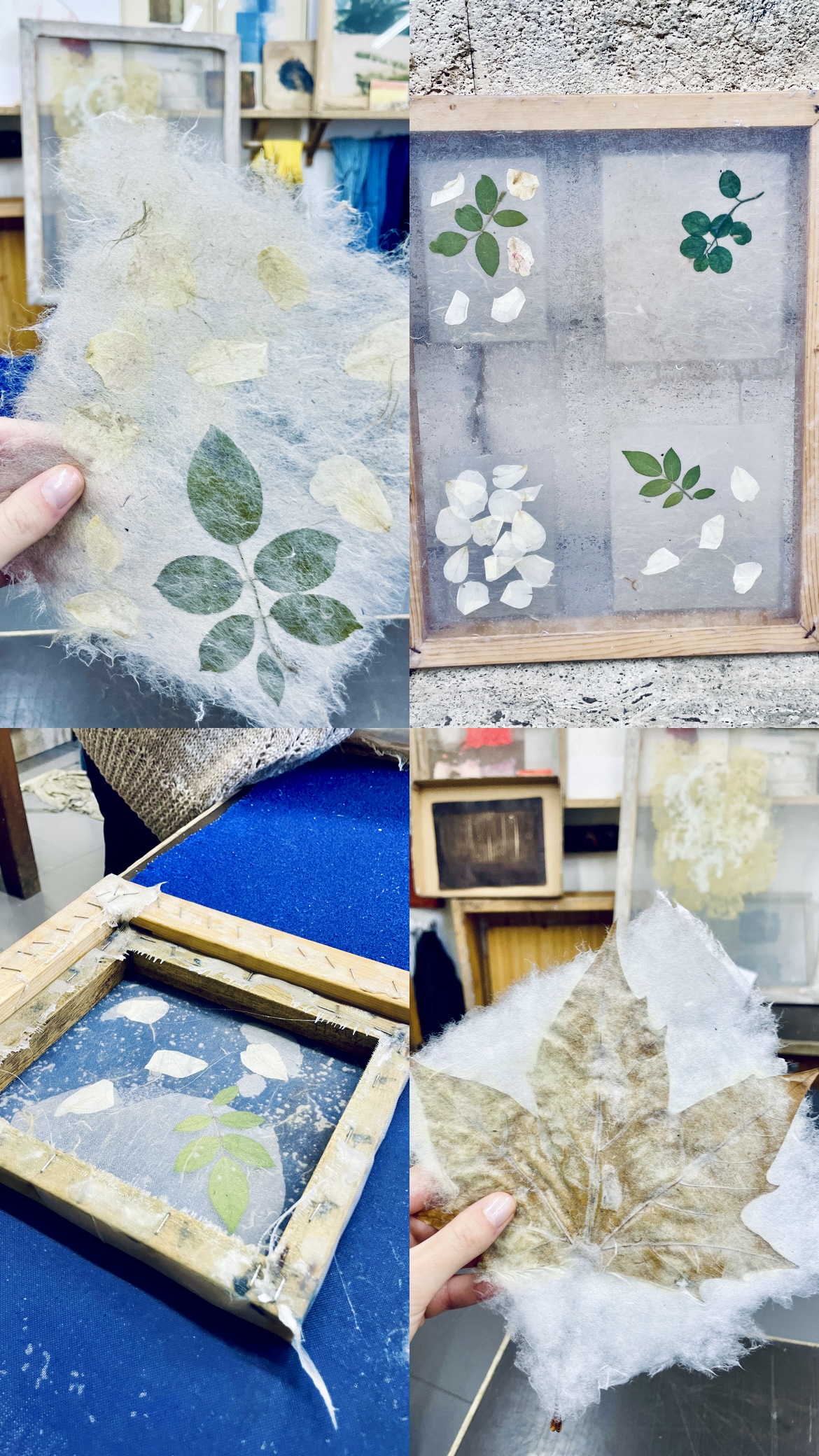
The Eastern techniques (tecniche orientali) introduced me to working with fibres from plants like abaca and mulberry bark (gelso), as used for Hanji paper. After boiling and beating, the fibres were suspended in water, then scooped up using a flexible bamboo screen (sugeta). A sponge was used to press and flatten the layers for an even sheet.

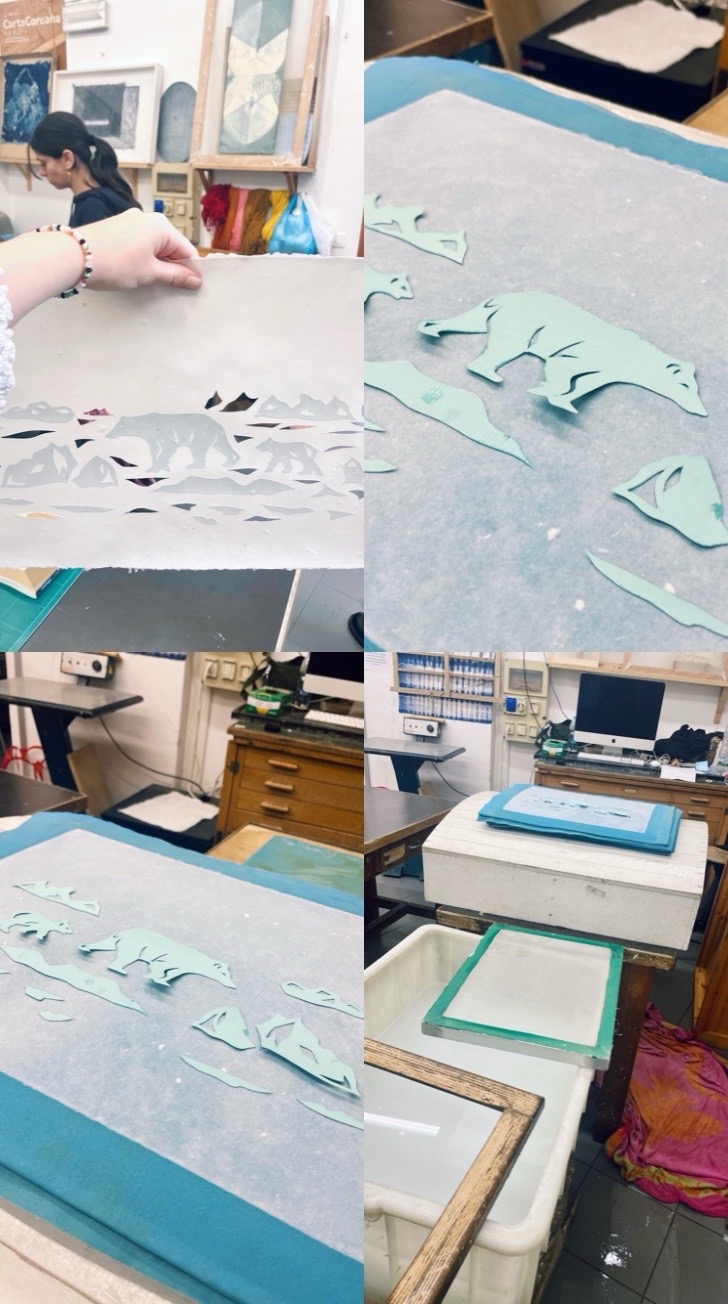
My project was an illustrated book featuring paper cutouts (ritagli di carta) inspired by the Chinese paper cutting tradition (intaglio della carta cinese). Using the Western papermaking technique, I created a piece that told a story about melting ice and environmental degradation. I cut out shapes of icy landscapes and polar bears, placing them between two layers of handmade paper. To add depth and transparency, I incorporated additional cutouts into the composition, creating a three-layered effect. This approach enabled greater interactivity between the pages and visually highlighted the fragility of the environment.
When working with oriental paper, I created compositions using real plants and flowers, which I dried together with the abaca fibres. The final result was soft and fluffy, with a delicate, natural appearance that reflected the organic materials embedded within the paper.
Tecniche dell’incisione
This hands-on course focused on traditional printmaking techniques (tecniche di incisione), particularly drypoint (puntasecca). Using a steel needle (punta secca), we etched directly into copper or zinc plates (lastra di rame o zinco), creating burrs (bave) that held the ink. The plates were inked (inchiostrazione), wiped (pulitura), and printed onto damp paper using an etching press (torchio calcografico).
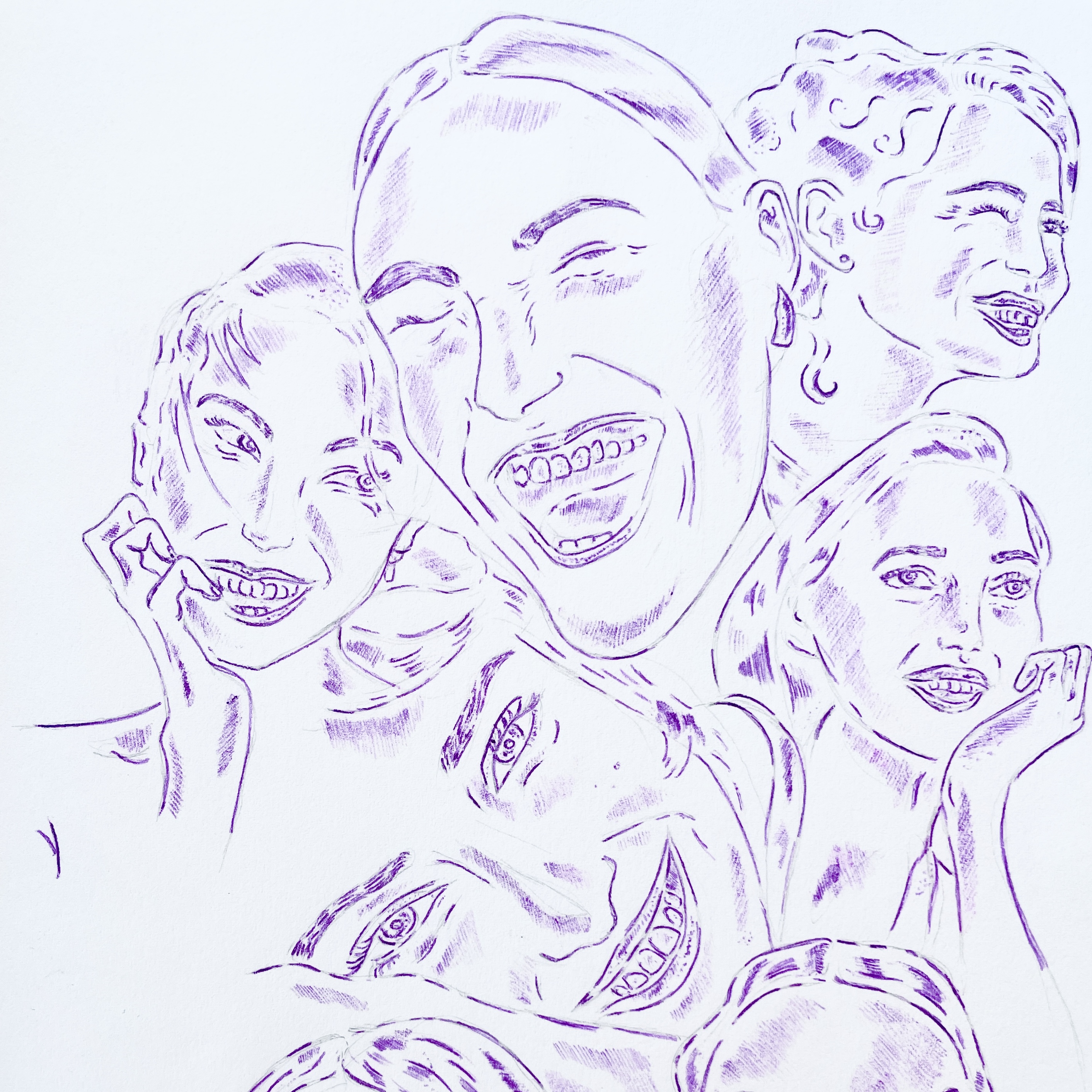
We also practiced etching (aquaforte), covering the plates with an acid-resistant ground (vermiculite), drawing into the ground, and then bathing the plates in acid (acetic acid). My project consisted of a series of experimental portraits, where I overlaid plates at various positions and proportions. This was a valuable exploration for my future master’s thesis.
Exam
Submission of a portfolio (portfolio) and oral presentation explaining the project’s concept.


Progettazione Grafica
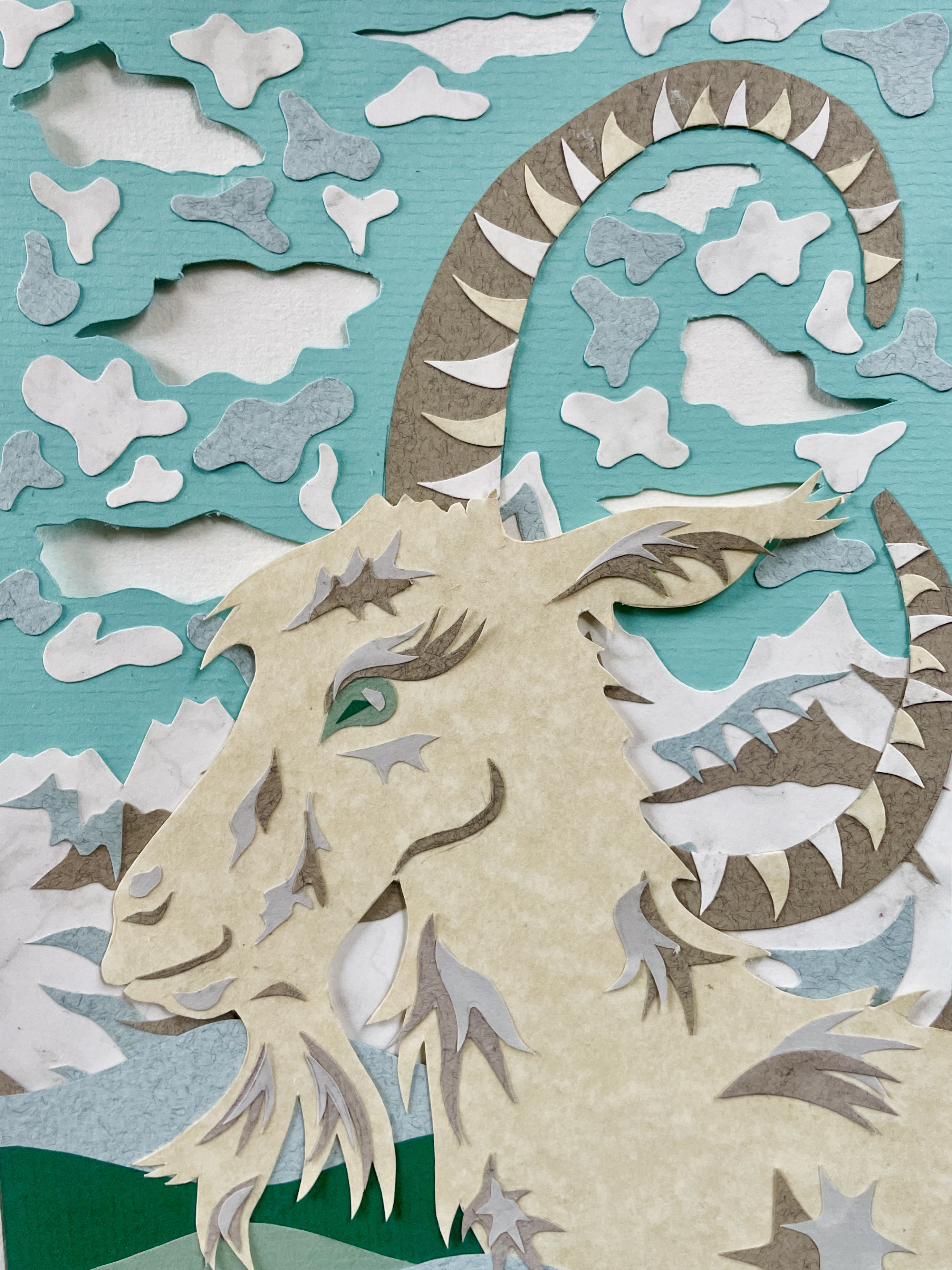
This course focused on paper collages and cutouts. As a group, we created an alphabet book (libro dell’alfabeto), with each student designing three letters, inspired by the work of Japanese designer Katsumi Komagata. A key aspect of the project was viewing the book not just as a flat object, but as something tactile and dimensional.
We explored the haptic qualities of different types of paper and experimented with how textures, layers, and materials could interact to create a more dynamic and sensorial reading experience. As part of the course, we attended the Più libri più liberi book fair, as well as a private presentation by Lazy Dog Press. I was particularly impressed by Linea by Alessandro Zanella, which was printed using a specialized intaglio technique (stampa calcografica).
Exam
Submission of the individually designed book pages and collaborative assembly of the final alphabet book.
(Letter C like “capra”)

Additional Courses at Campo Boario
The second campus, Campo Boario, is located outside the city centre, near Trastevere, and is close to the architecture faculty of Roma Tre University and the Mattatoio Museum. It’s an open, urban space with bunkers covered in graffiti, stray cats, and a small bar where students often gather after class. The focus here is on new media, digital techniques, and interactive projects, which align more closely with my field of Communication and Media Design.
Linguaggi Multimediali
This course focused on interactive media and multimedia projects. We worked with TouchDesigner, Processing, and Blender. Students were encouraged to develop their concepts and translate them into interactive applications. I collaborated with Alessia, an Italian student, to create an interactive tree (albero interattivo) using TouchDesigner. The tree grew in response to movements detected by a camera (interazione degli utenti). Its colours changed in real-time based on audio input (input sonoro).
In October 2025, the work will be exhibited in Milano. Hopefully, we will then have the space and equipment to document it in a better way. The exam consisted of presenting and demonstrating the project live, with submission of the original files and video documentation available via Teams.
Albero
Interattivo
Storia della Pubblicità
This theoretical course explored the history of advertising (storia della pubblicità) in Italy. Lectures were entirely in Italian. Topics included the development of Italian advertising campaigns (campagne pubblicitarie italiane), psychological effects of advertising (effetti psicologici della pubblicità), consumer-critical theories (teorie critiche del consumo), and semiotic and sociological analysis methods (analisi semiotica).
The exam was an oral analysis (esame orale) of an ad example chosen by the student, followed by questions on theories and key concepts.
Key Readings
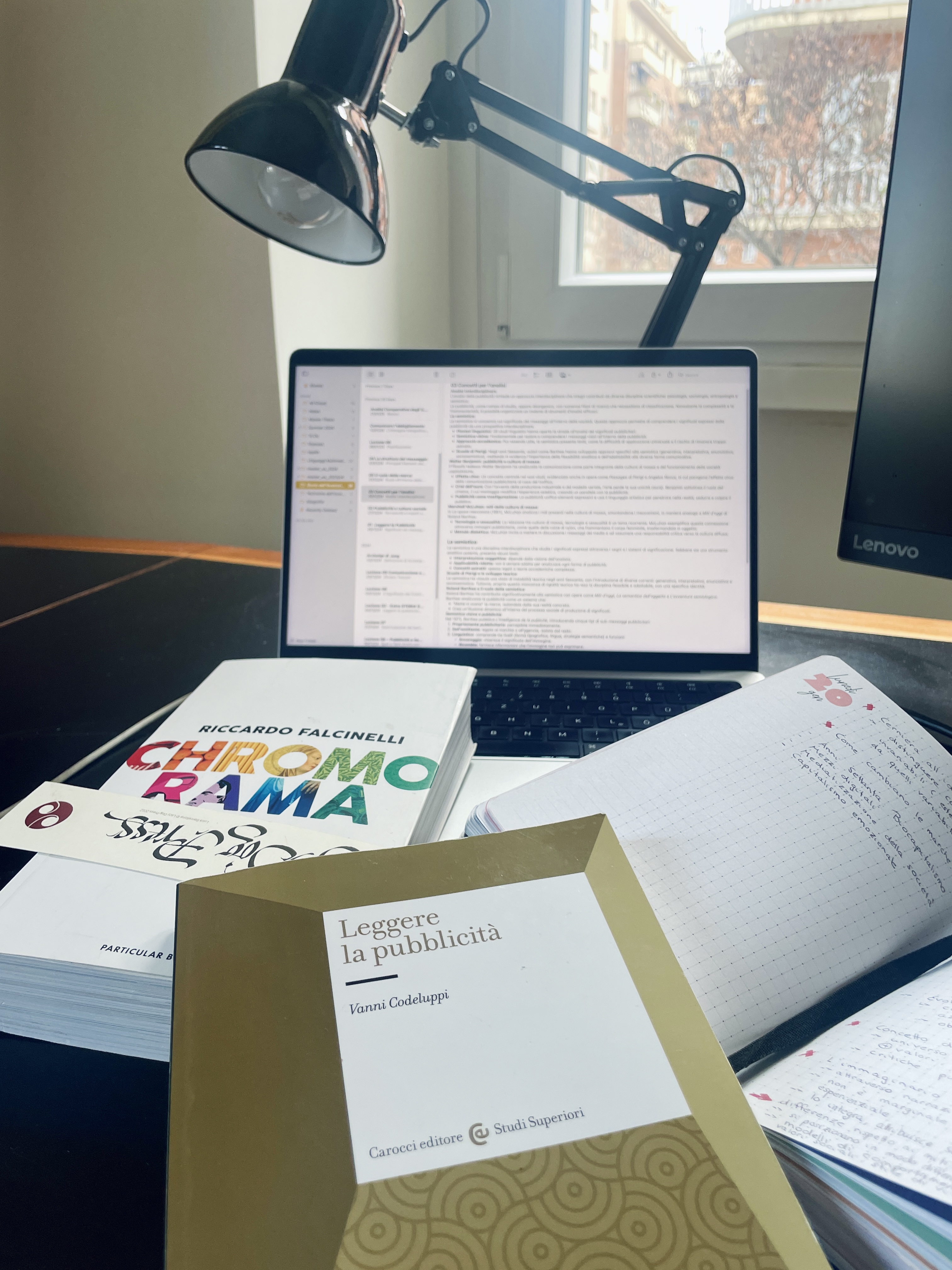
1. Cromorama by Riccardo Falcinelli – exploring the psychological, social, and symbolic power of colour (uso del colore).
2. Leggere la Pubblicità by Vanni Codeluppi – an introduction to advertising analysis (analisi della pubblicità) focusing on Italian print and TV ads since the 1950s.
Courses during the Summer Semester
During the summer semester, I continued the course in Progettazione Grafica with Marina Bindella. It was held weekly for an entire day, and students worked independently on a project for an illustrated book. In the winter semester, we had already discussed book design extensively and visited several exhibitions together. In the summer semester, our professor took us to her design studio in Trastevere and showed us some of the book projects she has been collaborating on over the past years. It was genuinely fascinating to see the diverse range of projects and the way manual printing and drawing techniques have been seamlessly combined with digital layouts and typography.
We reviewed all those books together and discussed them, delving into both technical details and the concepts of visual storytelling, coherence, and presentation. The great thing was that the professors at Accademia don’t see a book as a flat object that is supposed to be read linearly. They instead see it as a three-dimensional object, an artwork, a medium of free expression and storytelling. Every student was allowed to come up with a concept for their book freely.
Since we were a small group, we always sat in a circle every week and shared our processes. The conversations were intense and detailed, and I learned a great deal by discussing the work of the other students. Regarding manual techniques, I could learn extensively from the Italian students who took numerous classes in manual bookbinding, paper production, and a wide range of printing techniques. Whereas design education in Austria leans heavily toward digital tools, here I was immersed in tactile experimentation. Students crafted physical prototypes with layered papers, textures, and bindings, an approach that made each project feel more tangible and grounded.
During the semester, I worked on two projects. One was a smaller illustrated book I created for myself and the course, the other was the practical project for my thesis, which also happened to be an illustrated book. In the smaller project, I created a book featuring different variations in facial proportions for various personalities. In the bigger project, I depicted a wider range of facial emotions, abstracting them in steps. I moved from very detailed line drawings to simplified outline illustrations to pure abstraction. It was helpful to attend class every week and ask my professor and classmates for their perspectives, viewpoints, and opinions. They heavily inspired me in my creative process and taught me so many new things.
The Bologna Children’s Book Fair
My friend Lotte and I seized the chance to attend the Bologna Children’s Book Fair, held from March 31 to April 3, 2025. The Bologna Children’s Book Fair (BCBF) is the world’s leading event in the publishing industry, attracting visitors from around the globe. It featured over 1,500 exhibitors from more than 90 countries, bringing together publishers, illustrators, authors, designers, agents, and industry professionals under one roof. Children’s books are not only a major commercial rights fair but also serve as a global laboratory for visual culture and illustration trends.
For us, this fair was an invaluable window into the Italian publishing world. We saw firsthand how creative vision and commercial viability intersect. There was a constant tension between preserving conceptual and artistic integrity and ensuring market appeal. This duality underscores that authenticity and accessibility need not be mutually exclusive; rather, understanding how they interact is key to successful publishing. Walking through the fair’s vast exhibition halls, spanning over 20,000 m² of meticulously curated displays, I was struck by the extraordinary diversity of visual languages. From meticulously hand-drawn, narrative-rich spreads to bold, abstract interpretations, it was clear that culture and context profoundly shape visual storytelling.
Among the highlights were talks about Katsumi Komagata and Bruno Munari, whom we had studied extensively during the winter semester at the Accademia. Their intuitive, playful approaches to book design remain two of the most influential innovations in the field. Outside the fair, Bologna itself proved to be an amazing and inspiring city. With its medieval red-brick arches, lively student cafés and bars, and a reputation for left-leaning, alternative culture, the city felt both rooted in history and vibrantly modern. We also explored exhibitions by artists such as Ai Weiwei, further enriching our experience.
After my return to Rome, we dedicated a class session to sharing everything we had seen and experienced. We exchanged personal impressions, delved deeper into the portfolios of our favorite illustrators, and discussed the practical challenges of finding a publisher and bringing a book to market. Our more experienced classmates, many of whom already had industry contacts, offered helpful advice, guiding us through the complexities of contracts, print runs, and distribution. Overall, the Bologna fair and the discussions that followed not only inspired us creatively but also equipped us with a clearer understanding of how to navigate the publishing landscape.
Organization & Student Life
The organizational side at the Accademia di Belle Arti di Roma was, honestly, quite chaotic. Although there was an introductory meeting for Erasmus students, we were left mainly to arrange our course schedules (piano di studi) independently. In central and southern Italy, administrative processes often move slowly, and I was frequently shuffled from one secretary to another because no one felt fully responsible. Navigating these procedures was especially challenging given the paperwork requirements of my home university. Nevertheless, I eventually secured all the necessary documents and signatures to hopefully finalize my Erasmus stay, and the experience was well worth the effort.
As an Erasmus student, you can enroll in as many courses as you like, with complete freedom. The real challenge lay in coordinating everything with my home university to ensure credit recognition and avoid timetable clashes. Commuting between the two campuses, Campo Boario and Via Ripetta, could be stressful, particularly around midday when the metro is at its busiest. Despite the bureaucracy, I’m grateful for the chance to explore such a diverse range of courses and engage with a varied student body. It was inspiring to experiment with new approaches and gain fresh perspectives on communication design philosophies.
All classes were held in Italian, so having a B2 to C1 level was very helpful, especially for the more theoretical and technical courses at Campo Boario. Students with more limited language skills might prefer the hands-on, practical classes at Via Ripetta, which require less intensive theory and where professors are usually happy to provide extra support to international student participants. In the bachelor’s program, there is a fair number of Erasmus students, particularly from Spain, making it easier to find peers to connect with. To my knowledge, language classes at the beginner level and B1 levels are also offered to internationals, with ECTS credits available. However, I did not attend them and therefore cannot comment on their teaching methods. In the master’s courses, international students are the exception rather than the rule, but I had no difficulty being integrated. My classmates were genuinely curious about my background and always eager to hear how I came to join their program.
Housing & Life in Rome
Finding accommodation in Rome was difficult, especially during the Giubileo year. After a long search, I found a room in a shared apartment with an Italian student from Sapienza University. She was studying languages and we sometimes went out for an aperitivo together. Our apartment was between Tiburtina and Nomentano, near Policlinico metro station, which was ideal for commuting between Via Ripetta and Campo Boario. Being close to a metro station is very helpful in Rome, given the city’s size and transport limitations. Public transport is often chaotic, with metros stopping early and buses being unreliable.
I paid €750 per month, including utilities, which is a standard price in Rome. Luckily the Erasmus stipend I received helped a little to cover the higher costs for my rent. The flat was old, with minimal hot water and outdated appliances. But I didn’t come to Rome to sit in my apartment! The city’s beauty, food, and weather made it more than worth it.
Free Time & Culture
Rome offered endless leisure opportunities. With more attractions than I could explore in a year, and daily events and parties, there was always something happening. During my stay, I made it a point to visit nearly every art museum in the city. It was remarkable to experience both ancient sites such as the Forum, the Centro Storico, the Capitoline Museums, and the various villas with their classical paintings and sculptures, and a thriving contemporary scene at venues like the MAXXI Museum, Chiostro del Bramante, Palazzo delle Esposizioni, and the Galleria Nazionale d’Arte Moderna.
For outdoor escapes, the city’s parks were a delight. Villa Borghese, Villa Torlonia, Parco degli Acquedotti, and the Orto Botanico each offered a peaceful retreat. When I desired a broader change of scenery, day trips to Tivoli, San Marino, Frascati, or Castel Gandolfo were very easy to organize.
Rome is home to countless churches, each one surpassing the last in its Baroque architectural details and breathtaking interior frescoes. Cultural outings were also budget-friendly. As a student under 25, I often received free or reduced admission to museums. At art and design-related venues, showing a photo of my acceptance letter from the Accademia di Belle Arti often granted me free access. The MIC card, just €10 per year, provided free entrance to civic museums, and many state museums waived their fees on the first Sunday of each month.
For nightlife, I occasionally attended city-centre parties, but in the early weeks, I preferred aperitivi, which are relaxed gatherings perfect for conversation. An Aperol Spritz with stuzzichini typically costs around €4. My favorite evening districts were Monti, Trastevere, San Lorenzo, Garbatella, and the historic centre.
Although rents were high, dining and grocery costs in Rome tended to be lower than in Austria. Coffee and gelato were not only more affordable but also of incomparable quality. Roman cuisine was a true highlight. Classics like Cacio e Pepe (pasta with Pecorino Romano and black pepper) and Amatriciana (pasta with tomato sauce and Pecorino) became some of my favorite dishes. I also loved Supplì (fried rice balls filled with mozzarella) and the city’s famous artichokes, Carciofi alla Romana (braised with mint and garlic) and Carciofi alla Giudia (deep-fried until crispy).
For exceptional pasta, Osteria da Fortunata and La Piccola Cuccagna were standouts, and Mariuccia quickly became my go-to for Neapolitan pizza (a more fluffy version compared to the thin crust of the Roman style). I generally avoided restaurants in the historic centre as they tend to be overpriced, of lower quality, and often staffed by cooks without authentic Italian training. My rule of thumb was to bypass any restaurant with a greeter outside or menus illustrated with photographs.
Dinner in Italy is a late-night affair, typically kicking off around 21:00, so it’s worth booking ahead at popular restaurants. For breakfast, I became obsessed with Maritozzo con Panna (a pillowy sweet bun loaded with whipped cream) and Cornetti from cafés like Le Levain, Faró, Casina del Lago, Barnum, Shell, and Giufà. The city’s gelato and tiramisù were absolutely unmatched. My top picks were Giolitti, Fatamorgana, Fassi, and Gelateria la Romana. For takeaway tiramisù, the place to go is Two Sizes near Piazza Navona in the historic center.
To really immerse myself in the culinary scene, I signed up for several cooking courses where I learned the art of handmade pasta, which turned out to be a brilliant way to bond with other Erasmus students. We mastered classics like Busiate all’Amatriciana, ravioli, and tagliatelle. Outside the kitchen, I took advantage of free yoga and dance classes in Villa Borghese, and joined organized day trips around Italy, all of which added even more memorable experiences to my time there.
Roman Summer
Overall, social life in Rome was wonderfully spontaneous. A planned stroll through one neighborhood often led to unexpected discoveries in another, revealing hidden gems I never knew existed. Beyond its authentic, beautiful historical center, Rome’s outer districts each have their own distinct vibe. San Lorenzo and Pigneto exude an alternative atmosphere, Prati feels laid back and elegant, and EUR is remarkably clean and modern. The city is vast and versatile. There’s always something new to see, and you can easily find yourself in a completely unfamiliar corner.
In the summer semester, everything changed for me. During winter, I experienced Rome as a visitor, a tourist looking in from the outside. I had so much fun, saw countless amazing sights, and lived within the Erasmus bubble, which can be somewhat superficial. You meet many people, yet connections often remain fleeting. That environment did push me to become more open and communicative, but after a while, I craved deeper, more meaningful relationships. In the second half of my stay, I finally felt I had truly arrived and settled into the city. I gained a local perspective and forged several genuine friendships with people who had lived in Rome for years, including internationals from India, Vietnam, and Ecuador, as well as native Italians. While I continued to explore new places, I also immersed myself in authentic Roman life, including late nights in Trastevere and visits to relaxed, off the beaten path spots unknown to most tourists. The city grew familiar and I navigated it with confidence, yet I remained curious, always ready to rediscover hidden corners. Although Rome continued to surprise me, it gradually began to feel more like home.
That summer was full of events. The Italian dating culture proved entirely different from what I knew. Intense, emotional, and intuitive, it reshaped my perspective and left me with countless memories and stories to share. My Italian also reached a new level. I no longer pause before speaking, and although I still make the occasional mistake, the language now flows naturally. Weekends were spent escaping the heat with trips to nearby beaches like Ostia, Anzio, and Santa Marinella, all within an hour by train, and to lakes like Castel Gandolfo for swimming. We also took day trips to Florence, Tivoli, and Castiglione della Pescaia. Rome’s central location made it easy to explore both northern and southern cities, each with its distinct vibe and character.
Summers in Rome are warm yet wonderfully relaxed, filled with vibrant evenings when you go with the flow and let the city lead you. Wherever you end up, you’re always greeted by beauty and something new to discover.
Conclusion
Choosing Rome for my exchange was one of the best decisions I’ve ever made. While life here can be chaotic, especially when it comes to public transport or paperwork, the city’s charm, vitality, and beauty more than make up for it. Rome taught me how to live more fully and feel more connected, both to people and to myself. Studying at the Accademia reshaped how I approach creative work. I became more comfortable navigating open ended projects without a rigid structure, which strengthened my confidence and intuition as a designer. This hands on, analog exploration helped me reconnect with the physical dimension of design, something I hadn’t realized I was missing until I rediscovered it in Rome. At the same time, my Italian improved dramatically, allowing me to engage more deeply with local life, whether chatting over an Aperol Spritz in Trastevere or discussing paper making techniques between classes.
On a personal level, my time in Rome transformed my outlook. Efficiency and high achievement are no longer my sole priorities. I now understand that joy, pleasure, beauty, and human connection are equally, if not more, valuable. Despite the city’s occasional messiness and the fact that many Romans live on tighter budgets than we do in Austria or Germany, they exude a richness of happiness and zest for life that is truly inspiring. Looking ahead, I’m excited to carry Rome’s spirit into whatever comes next. I want to integrate its tactile, human centered approach into my design practice, blending analog craftsmanship with digital innovation. Although I’m still exploring which exact path to take, I imagine a trilingual, international career, one that keeps me rooted in a European city where beauty and culture abound.
Saying goodbye was bittersweet. Leaving behind friends, dreams, and countless memories was one of the hardest things I’ve done. Yet these months have left an indelible mark on me, and if I had the choice again, I would come to Rome without hesitation, or to another European city with its unique vibe. Rome didn’t just change my semester, it changed my life.


 Sofie Neudecker
Leave a comment